
Breast Cancer Awareness: Why Early Detection Matters
Updated On :-
October 1, 2026
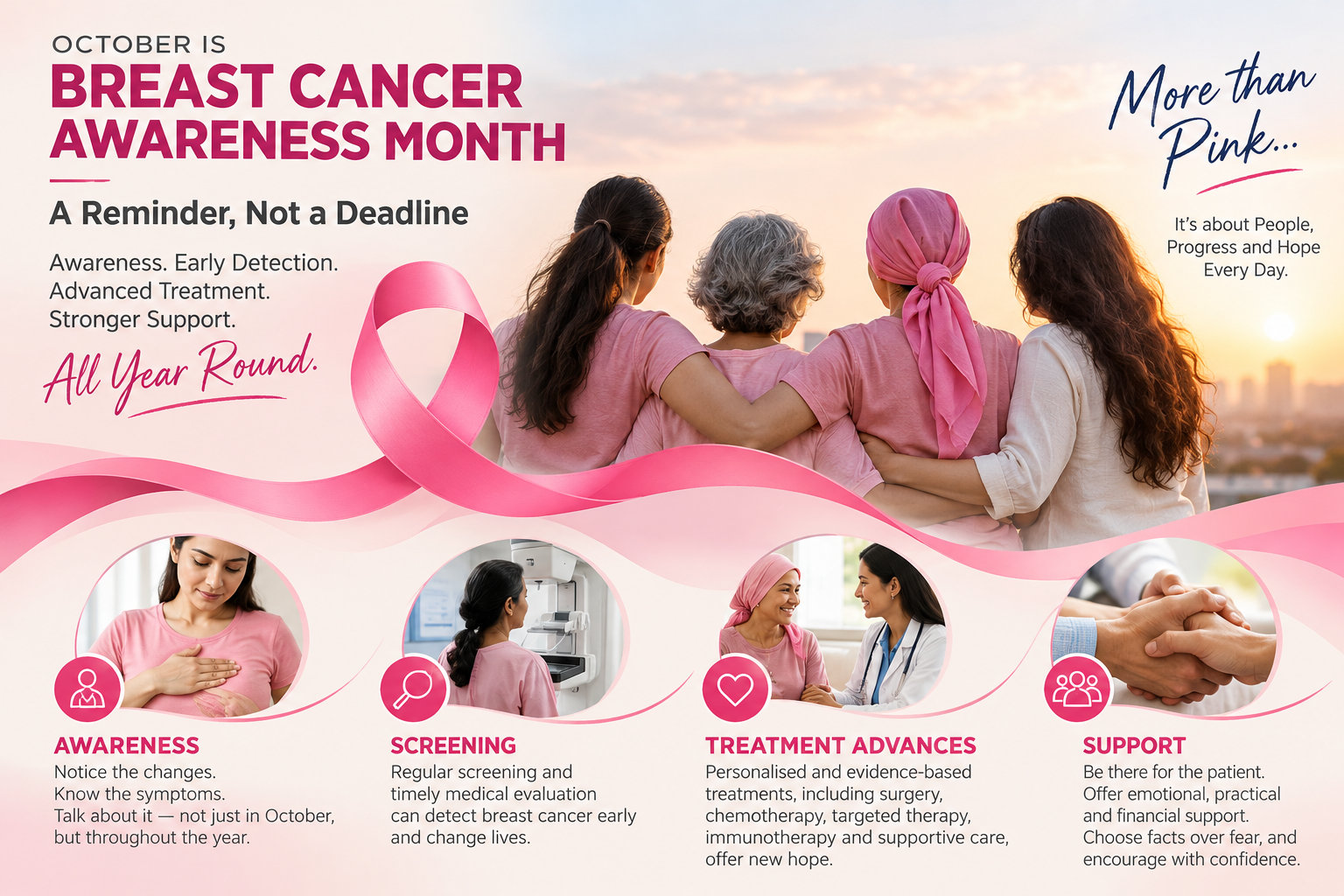
October is Breast Cancer Awareness Month. But breast cancer awareness should not begin in October and disappear when November arrives. It should become a part of our everyday health habits—recognising changes, understanding screening, seeking timely medical advice and standing beside those going through treatment.
Every October, the colour pink becomes more visible. Hospitals organise awareness programmes, screening initiatives are promoted, social media carries messages about breast cancer, and conversations that may otherwise remain uncomfortable become easier to start. This visibility is valuable. But perhaps the more important question is: What happens after October ends?
Breast cancer does not follow a calendar. It does not wait for Breast Cancer Awareness Month to arrive. In India, breast cancer remains the most commonly diagnosed cancer among women. According to IARC's GLOBOCAN 2022 data, India recorded approximately 192,000 new breast cancer cases among women in 2022, accounting for 26.6% of all new cancers among Indian women.
These numbers represent far more than statistics. Behind every diagnosis is a woman whose life, family and future may suddenly feel uncertain. This is why breast cancer awareness needs to go beyond campaigns and ribbons. It needs to become a habit.
Awareness Should Not Be Limited to October
Imagine a woman telling a friend, sister or colleague, “I have noticed a lump in my breast.”
What should the response be?
It should not be, “Don't worry, it will probably go away.” It should not be, “It is probably hormonal.” And it should not be, “Wait for a few weeks and see.”
The simplest and most responsible response is: “Please get it checked.”
A breast lump does not automatically mean cancer. In fact, many breast lumps are benign. But a new or unusual change deserves appropriate medical evaluation. The World Health Organization advises that an abnormal breast lump should be medically assessed, even when it is painless. Other changes that may require attention include changes in breast size or shape, skin dimpling or redness, changes around the nipple and abnormal or bloody nipple discharge.
The important point is not to diagnose ourselves. The important point is to recognise that something has changed and not ignore it.
This is where every one of us can contribute to breast cancer awareness. If someone we know mentions an unusual breast change, we can encourage her to seek medical advice. That small conversation may prevent a delay in diagnosis.
Awareness, therefore, is not simply knowing what breast cancer is. Awareness is knowing what to do when something does not feel right.
Early Detection Can Change the Breast Cancer Journey
One of the most important messages during Breast Cancer Awareness Month is the importance of early detection.
Breast cancer detected at an earlier stage may be more amenable to effective treatment, and early diagnosis can improve the chances of successful treatment while reducing delays and complications. WHO identifies early diagnosis and screening as two important components of early detection.
It is important, however, to understand the difference between screening and diagnosis.
Screening is performed in people who do not have symptoms, with the aim of identifying disease before it becomes clinically apparent. Mammography is an established breast cancer screening tool, although the appropriate screening approach depends on age, risk profile and the healthcare setting.
On the other hand, a woman who has already noticed a new lump or another concerning change should not simply wait for her next routine screening appointment. She should seek appropriate clinical evaluation.
This distinction is important because the goal is not simply to “get a test.” The goal is to identify abnormalities at the right time and ensure that appropriate evaluation and treatment follow.
For India, this message is particularly important. IARC notes that breast cancer is among the most common cancers in the country and that early detection can play an important role in reducing the cancer burden.
Screening and awareness programmes therefore have value not only in October but throughout the year. Women's health programmes, community awareness initiatives, primary healthcare education and easier access to diagnostic services can help reduce the delay between noticing a change and receiving appropriate care.
What Happens After the Diagnosis Matters Too
There is another aspect of breast cancer awareness that deserves much more attention: support after diagnosis.
When a woman is told that she has breast cancer, the diagnosis can bring an overwhelming number of questions.
Will I need surgery?
Will I need chemotherapy?
Will I lose my hair?
Can I continue working?
What will happen to my family?
How much will treatment cost?
Will I recover?
These questions are not merely medical. They are emotional, social, practical and financial.
This is where families and friends can make an enormous difference.
Supporting a patient does not always require knowing exactly what to say. Sometimes it means accompanying her to the hospital, helping her understand what the doctor has explained, ensuring that investigations and appointments are completed on time, helping with transportation, assisting with treatment-related responsibilities or simply sitting beside her when she is frightened.
A patient should not feel that she has to navigate cancer alone.
Financial support can also be an important part of cancer care. Depending on eligibility, families may explore health insurance, government healthcare schemes, charitable organisations, NGOs and other forms of financial assistance. The treating healthcare team can often help patients understand what legitimate support may be available.
But there is another responsibility that families should remember: do not confuse the patient.
Breast Cancer Treatment Has Changed
Perhaps one of the most encouraging developments in breast cancer care is how significantly treatment has evolved.
Breast cancer treatment is increasingly personalised. Depending on the type and stage of disease, treatment may involve surgery, radiation therapy, chemotherapy, hormone therapy, targeted therapy and, for selected patients, immunotherapy.
Modern treatment increasingly asks not only, “Where is the cancer?” but also, “What type of cancer is this biologically?”
For example, biomarker testing can identify hormone receptors such as estrogen and progesterone receptors and HER2 status. These results can help doctors determine which treatments may be appropriate for an individual patient.
Targeted therapies are an important example of this shift towards personalised cancer treatment. They are designed to act on specific features of cancer cells and may be used for selected patients whose tumours have relevant biomarkers.
Immunotherapy has also become part of treatment for selected breast cancer patients, particularly certain patients with triple-negative breast cancer.
Therefore, the image of breast cancer treatment as simply “surgery followed by chemotherapy” no longer reflects the full reality of modern oncology.
Supportive Care Is Also Part of Modern Cancer Care
Treatment advances are not limited to medicines.
For many patients, the experience of cancer treatment is also shaped by its side effects and its impact on everyday life.
One example is chemotherapy-induced hair loss. For some patients receiving appropriate chemotherapy regimens, scalp-cooling technology can help reduce hair loss. This may appear cosmetic from the outside, but for the person receiving treatment, hair can be closely connected to identity, confidence and emotional wellbeing.
Similarly, infection prevention and a safe treatment environment are important considerations, particularly for patients whose immune systems may be weakened during cancer treatment. Appropriate ventilation and HEPA filtration can form part of infection-control strategies in healthcare environments where reducing airborne infectious risks is important.
Modern oncology is therefore not simply about treating the tumour.
It is increasingly about treating the person who has the tumour.
Going Beyond the Pink Ribbon
There is an important conversation emerging around breast cancer awareness itself: perhaps awareness needs to go beyond the colour pink.
Pink ribbons have played an important role in making breast cancer visible. But a campaign should ultimately lead to action.
True awareness means that a woman knows which changes should not be ignored.
- It means that families understand the importance of timely medical evaluation.
- It means that screening is discussed responsibly rather than treated as a one-size-fits-all exercise.
- It means that patients receive evidence-based information rather than a collection of frightening stories from relatives and acquaintances.
- It means understanding that breast cancer is not one disease and that treatment can be personalised.
- It means supporting patients emotionally and financially when possible.
- And it means remembering that a cancer diagnosis does not remove a person's need for dignity, independence, confidence and hope.
Let October Be the Reminder
Perhaps the most meaningful way to observe Breast Cancer Awareness Month is to stop thinking of October as the month when we become aware of breast cancer.
Instead, let October be the month that reminds us to remain aware throughout the year.
If a woman notices a new breast lump in January, she should know what to do.
If someone mentions an unusual nipple change in April, we should encourage her to seek medical advice.
If a family member receives a diagnosis in July, we should know how to support rather than frighten her.
And if someone begins treatment in December, we should remind her that modern cancer care is not only about fighting the disease—it is also about helping her live through the treatment with the best possible support and dignity.
Breast cancer awareness should therefore move beyond an annual campaign.
October can start the conversation. But our actions throughout the year are what give that conversation meaning.
- Notice the change.
- Do not delay the consultation.
- Understand screening.
- Seek evidence-based treatment.
- Support the patient.
- Do not confuse her with unverified advice.
- And above all, do not let her feel that she is alone.
Because breast cancer awareness should not be a one-month responsibility. It should become a year-round culture of vigilance, early detection, informed treatment and compassion.
A note for readers
This article is intended for awareness and educational purposes and does not replace individual medical advice. Screening recommendations and treatment decisions should be discussed with an appropriate healthcare professional based on age, symptoms, personal risk, family history and individual medical circumstances.